Litsea Cubeba Myths: Five Common May Chang Misconceptions
Litsea cubeba, better known in perfumery and aromatherapy circles as may chang, has picked up a strange amount of folklore for an oil that most people couldn't identify by sight. Part of the confusion comes from its bright, lemony scent, which invites comparisons to oils it has nothing in common with botanically. Part of it comes from marketing shorthand that gets repeated so often it starts to sound like fact. This article works through five of the most common litsea cubeba misconceptions we hear from customers and readers, weighing each one against what research suggests and what evidence indicates about the oil's chemistry, sourcing, and real-world use. Think of it as a working reference for anyone trying to separate may chang oil facts from the stories that have grown up around them.
Myth 1: Litsea Cubeba Is Just a Substitute Name for Lemongrass or Verbena
The myth: "Litsea cubeba, lemongrass, and verbena oil are basically the same thing sold under different labels."
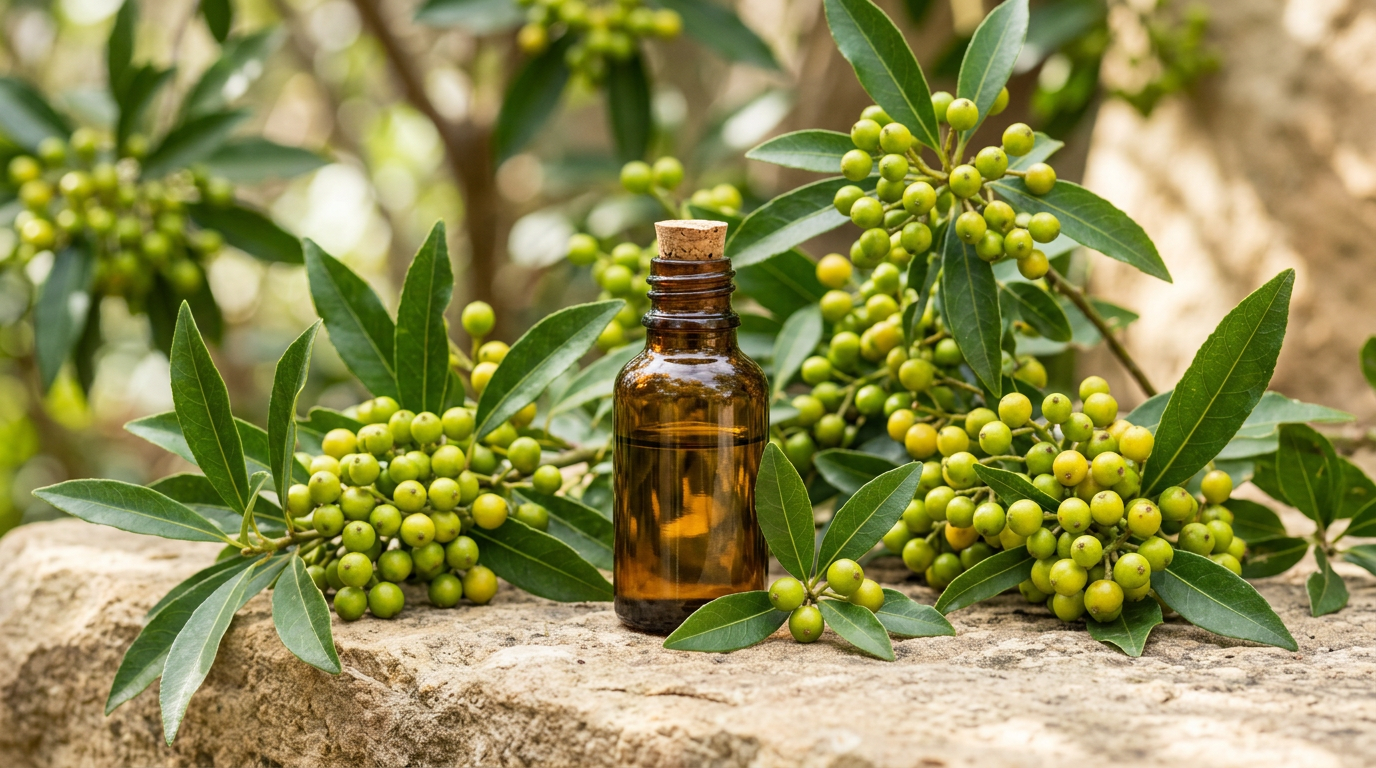
This is one of the most common litsea cubeba myths, and it's easy to see how it started. All three oils share a citrus-forward, slightly green top note, and all three lean heavily on citral as a dominant aromatic compound. But that's where the resemblance ends. Litsea cubeba comes from a small tree in the Lauraceae family, native to parts of China, Taiwan, and Southeast Asia, and the oil is distilled from its tiny pepper-like fruit. Lemongrass belongs to the grass family Poaceae, and its oil comes from the leaf blades of a completely different plant. Lemon verbena, meanwhile, is a shrub in the Verbenaceae family, and true verbena oil is now rare and expensive because the plant yields so little.
Gas chromatography testing consistently shows that while these three oils overlap in citral content, they diverge in the trace constituents that round out an oil's character: the specific ratios of limonene, citronellal, geraniol, and dozens of minor compounds present in single-digit percentages. Those trace differences are exactly what a trained nose can pick up when comparing the oils side by side. Litsea cubeba tends to read as brighter and more fruit-like, while true verbena carries a softer, almost floral undertone that's part of why it commands such a premium.
The myth persists partly because history gave it a running start. For decades, litsea cubeba was marketed to perfumers as an affordable stand-in for verbena, since genuine verbena oil was scarce even a century ago. That substitution history got flattened over time into the idea that the oils are interchangeable, when in fact litsea cubeba earned its place as a respected aromatic in its own right, not merely a stunt double for something else.
Myth 2: Is Wild Harvested Litsea Cubeba Better? The "Wild Always Wins" Assumption
The myth: "Wild harvested litsea cubeba is automatically higher quality than oil from cultivated trees."
This question comes up constantly: is wild harvested litsea cubeba better than the cultivated version? The honest answer is that origin story and quality are two different variables, and conflating them is one of the more expensive litsea cubeba misconceptions a buyer can hold. Wild harvesting means fruit is gathered from trees growing without cultivation management, often across scattered hillside stands. Cultivated litsea cubeba comes from managed groves where harvest timing, fruit ripeness, and post-harvest handling can be controlled more consistently.
Evidence indicates that consistency, not wildness, is the better predictor of a well-made batch. Wild-harvested fruit is frequently picked at mixed ripeness levels by different foragers over a spread of days, which can produce noticeable variation in citral content from one lot to the next. Cultivated sources, when managed by a supplier who prioritizes timing and fast distillation after harvest, often deliver a more predictable chemical profile lot over lot. Neither approach guarantees quality on its own. What actually determines the outcome is how quickly the fruit reaches the still after picking, how the distillation is run, and whether the supplier tests each batch rather than relying on a general reputation.
The appeal of "wild harvested" as a label is understandable. It suggests a closer connection to nature and a more artisanal process, and that story sells. But research suggests buyers are better served asking for a batch-specific certificate of analysis than assuming a wild origin automatically means a superior oil. A well-managed cultivated source with rigorous testing can easily outperform an inconsistently handled wild harvest, and the reverse is also true. The label alone doesn't tell you enough.
Myth 3: A Higher Citral Percentage Always Means a Higher Quality Oil
The myth: "The higher the citral number on the spec sheet, the better the litsea cubeba oil."
Genuine litsea cubeba oil typically tests in a citral range of roughly 70 to 85 percent, and that number has become a kind of shorthand for quality in the trade. But treating citral percentage as the single measure of a good oil overlooks how the rest of the chemical profile contributes to the finished scent. Citral establishes the sharp, lemony backbone, but the supporting cast, compounds like limonene, citronellal, and linalool present in smaller amounts, is what gives a well-made oil its roundness and depth rather than a flat, one-note citrus smell.
Some evidence indicates that oils pushed toward the very top of the citral range, especially through rectification or blending practices meant to hit a target number, can lose some of that supporting complexity in the process. A full gas chromatography and mass spectrometry report, not just a headline citral figure, is what actually shows whether an oil's overall profile lines up with what genuine litsea cubeba should look like. A skilled evaluator will also do a sensory check alongside the lab data, since a technically high citral number paired with a thin or off-balance scent is a sign something in the sourcing or processing chain cut corners elsewhere.
This myth exists because citral percentage is easy to print on a spec sheet and easy for a buyer to compare across suppliers at a glance. It's a real and useful data point, just not a complete one. Treating it as the whole story is a shortcut that skips over the parts of quality assessment that take more effort to communicate: full-spectrum testing, sourcing transparency, and how the oil actually smells once it's in the bottle.
Myth 4: Since It's Natural, Litsea Cubeba Oil Is Fine to Use Undiluted
The myth: "Essential oils come from plants, so applying litsea cubeba oil directly to skin is safe."
This is less a fact about litsea cubeba specifically and more a widespread assumption about essential oils in general, but litsea cubeba's high citral content makes it a particularly relevant example. Citral-rich oils are well documented as a common source of skin sensitivity when applied undiluted, and "natural" is not the same thing as "gentle." Concentration matters far more than origin when it comes to how skin responds to a botanical extract.
For anyone working litsea cubeba oil into a DIY blend, a few practical safety habits go a long way. Dilute properly before any skin contact, generally no more than about 1 to 2 percent in a carrier oil for a leave-on blend, and always patch test a small amount on the inner forearm and wait 24 to 48 hours before wider use. Keep the oil away from the eyes and mucous membranes, store it out of reach of children and pets, and discontinue use if the skin shows any redness or discomfort. People who are pregnant, nursing, or managing any ongoing health situation should check with a qualified healthcare provider before adding a new essential oil to a routine, since individual sensitivities vary widely and a personal consultation accounts for factors a general article can't.
The myth endures because "natural" carries a strong emotional association with "safe," and marketing around essential oils has leaned on that association for years. But concentrated plant extracts are, by definition, concentrated. Respecting proper dilution isn't an overcautious extra step. It's the difference between an oil that adds a pleasant note to a blend and one that causes a reaction nobody wanted.
Myth 5: All Litsea Cubeba Oil on the Market Is Basically the Same
The myth: "Litsea cubeba is litsea cubeba. One supplier's bottle is as good as another's."
Because litsea cubeba is produced in volume as a commodity aromatic, it's tempting to treat it as fungible the way you might treat a bulk grain. But origin, distillation practice, and testing rigor all leave a real fingerprint on the finished oil. Fruit grown and distilled in Fujian province smells and tests differently, in subtle but measurable ways, than fruit sourced from Jiangxi, Vietnam, or parts of Indonesia. Soil, climate, harvest timing, and the specific distillation setup a producer uses all shape the final aromatic profile.
Research suggests that batch-to-batch consistency varies considerably across suppliers, which is exactly why serious buyers ask for a current certificate of analysis rather than relying on the country of origin printed on a listing. Two bottles both labeled "litsea cubeba, steam distilled" can smell meaningfully different: one bright and fruity, another sharper and more medicinal in character, depending on how the fruit was handled between picking and distillation. Price-driven bulk purchasing in the commodity market tends to obscure these differences, since buyers comparing oils mainly on cost per kilogram have little incentive to ask deeper sourcing questions.
This misconception holds on because, at a glance, litsea cubeba oils really do look interchangeable: similar color, similar viscosity, similar base scent profile. It takes a side-by-side smell test or a lab report to reveal how much variation actually exists between suppliers, and that extra step is easy to skip when a purchasing decision comes down to a spreadsheet of prices.
What This Means for Choosing an Oil
None of these five litsea cubeba misconceptions are dramatic in isolation, but together they shape a lot of purchasing decisions that don't hold up under closer inspection. The species confusion leads people to swap oils that behave differently in a blend. The wild-versus-cultivated assumption steers buyers away from asking the questions that actually predict quality. Fixating on citral percentage alone skips the fuller picture a lab report and a sensory check together can offer. Treating any plant extract as automatically gentle skips real safety habits. And assuming all litsea cubeba is equivalent ignores genuine differences that show up the moment you compare two bottles side by side.
The throughline across all five is the same: evidence beats assumption. A batch-specific certificate of analysis, a clear account of sourcing and distillation, and a straightforward sensory comparison will tell a buyer more than any single number, label, or origin story on its own. Litsea cubeba has earned its reputation as a versatile, well-loved aromatic on its own merits. It doesn't need the myths to make it interesting.
Quick Reference: Myth vs. Fact
| Myth | What Evidence Indicates |
|---|---|
| Litsea cubeba is the same as lemongrass or verbena | Distinct species and families; overlapping citral content but different supporting compounds and scent character |
| Wild harvested oil is always better | Consistency and testing rigor predict quality more reliably than wild versus cultivated origin |
| Higher citral percentage means higher quality | Full chemical profile and sensory balance matter alongside the citral figure, not instead of it |
| Natural means safe to use undiluted | Citral-rich oils are a known source of skin sensitivity; dilution and patch testing remain essential |
| All litsea cubeba oil is interchangeable | Origin, distillation practice, and supplier testing produce measurable differences between batches |